
Nguni Boots vs Vellies: 7 Differences for Your Best Fit
Nguni boots vs vellies is a choice between two distinct expressions of South African leather footwear. Boots offer a taller profile and stronger visual presence, while vellies keep the familiar low-cut shape of veldskoene and move easily between casual outfits and relaxed smart wear. Both can showcase genuine Nguni hide, so the best option depends on coverage, fit, weather, wardrobe and the way you plan to use the shoes. These seven differences will help you compare them before ordering.
body.single-post .site-main{max-width:1140px;margin:0 auto;padding:64px 24px 88px;color:#342f2c} body.single-post .page-header{max-width:920px;margin:0 auto 34px;text-align:center} body.single-post .page-header .entry-title{margin:0;font-size:clamp(34px,4.5vw,58px);line-height:1.08;letter-spacing:-.025em;text-transform:none!important;color:#2b2927} body.single-post .page-content{max-width:860px;margin:0 auto;font-size:17px;line-height:1.82;color:#514a46} body.single-post .page-content>p:first-of-type{font-size:21px;line-height:1.65;color:#342f2c} body.single-post .page-content h2{margin:52px 0 18px;font-size:clamp(27px,3vw,38px);line-height:1.2;color:#2f2925} body.single-post .page-content h3{margin:34px 0 12px;font-size:23px;line-height:1.3;color:#3a312c} body.single-post .wp-block-image{margin:34px auto} body.single-post .wp-block-image img{width:100%;max-height:620px;object-fit:cover;border-radius:20px;box-shadow:0 18px 48px rgba(50,38,29,.14)} body.single-post .wp-block-image figcaption{margin-top:10px;color:#756960;font-size:14px;text-align:center} body.single-post .wp-block-table{margin:30px 0;overflow-x:auto} body.single-post .wp-block-table table{border-collapse:collapse;width:100%} body.single-post .wp-block-table th,body.single-post .wp-block-table td{padding:14px;border:1px solid #ded7d1;text-align:left} body.single-post .hon-video{position:relative;padding-bottom:56.25%;height:0;overflow:hidden;margin:34px 0;border-radius:20px;box-shadow:0 18px 48px rgba(50,38,29,.14)} body.single-post .hon-video iframe{position:absolute;inset:0;width:100%;height:100%;border:0} body.single-post .hon-faq details{margin:12px 0;padding:18px 20px;border:1px solid #ded7d1;border-radius:12px;background:#faf8f6} body.single-post .hon-faq summary{cursor:pointer;font-weight:700;color:#342f2c} body.single-post .wp-block-button__link{background:#342f2c;color:#fff;border-radius:999px;padding:14px 24px} body.single-post #rank-math-toc{margin:34px 0;padding:24px 28px;border:1px solid #ded7d1;border-radius:16px;background:#faf8f6} body.single-post #rank-math-toc h2{margin:0 0 14px;font-size:24px;line-height:1.25} body.single-post #rank-math-toc ul{margin:0;padding-left:22px;columns:2;column-gap:36px} body.single-post #rank-math-toc li{margin:7px 0;break-inside:avoid} body.single-post #rank-math-toc a{color:#5a4337;text-decoration:underline;text-underline-offset:3px} @media(max-width:720px){body.single-post #rank-math-toc ul{columns:1}}Contents
Nguni boots vs vellies at a glance
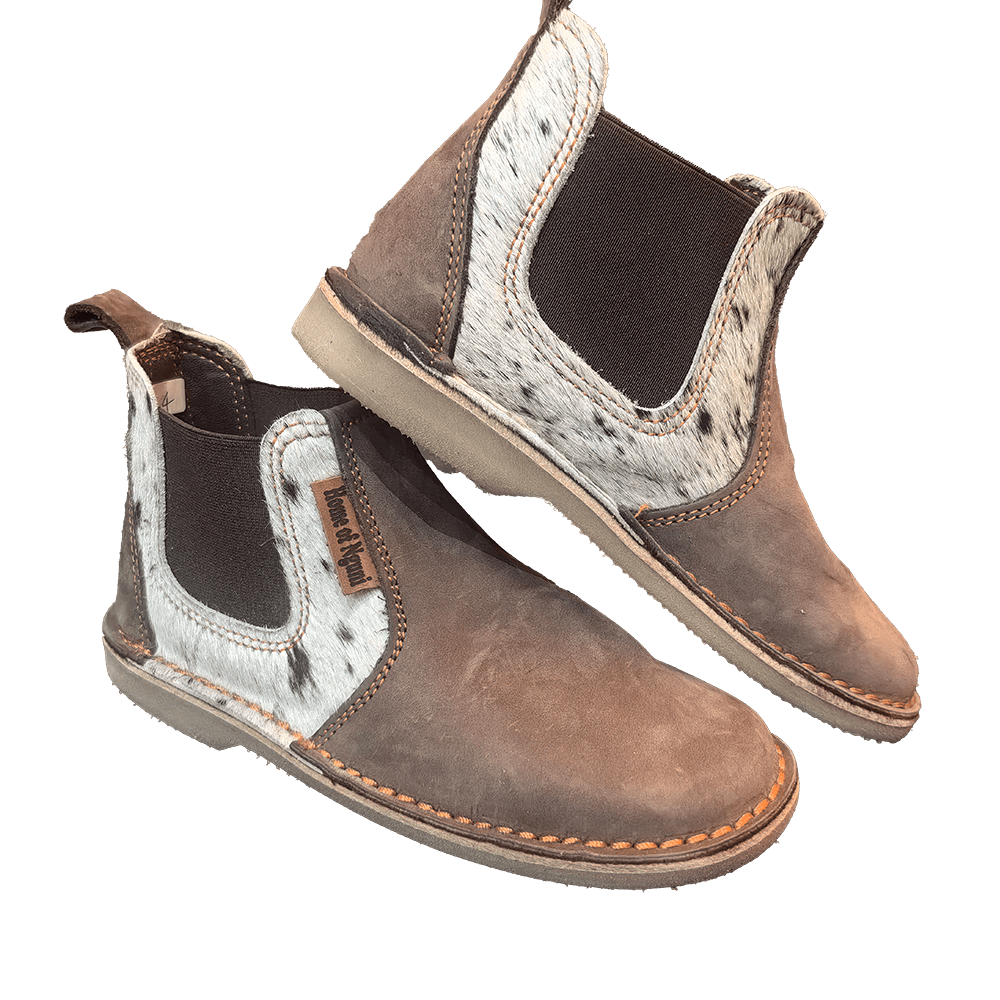
When comparing Nguni boots vs vellies, both styles celebrate natural pattern and local character, but they serve different wardrobes. A boot rises higher around the ankle and lower leg. A vellie is traditionally a low or ankle-height field shoe with a simple, versatile profile. Because genuine Nguni markings vary, the exact balance of dark, light, brown, white or brindle hair-on-hide also changes from pair to pair.
| Feature | Nguni boots | Nguni vellies |
|---|---|---|
| Profile | Taller and more prominent | Low-cut and understated |
| Coverage | More ankle and lower-leg coverage | More open around the ankle |
| Styling | Strong focal point for cool-weather looks | Easy with everyday casual and relaxed smart outfits |
| Putting on | May need more time and trouser planning | Usually quick and simple |
| Pattern impact | Larger visible footwear statement | Focused accent below the hem |
| Best first check | Calf, shaft and ankle fit | Foot length, width and sock choice |
1. Height and coverage
In a Nguni boots vs vellies comparison, the clearest difference is height. Boots extend above the ankle, creating more coverage against cool air, dust and light vegetation. Their taller shape also occupies more visual space, especially with a skirt, dress or tucked-in trousers. Browse the ladies Nguni boots or men’s Nguni boots to see how that upright profile carries the natural pattern.
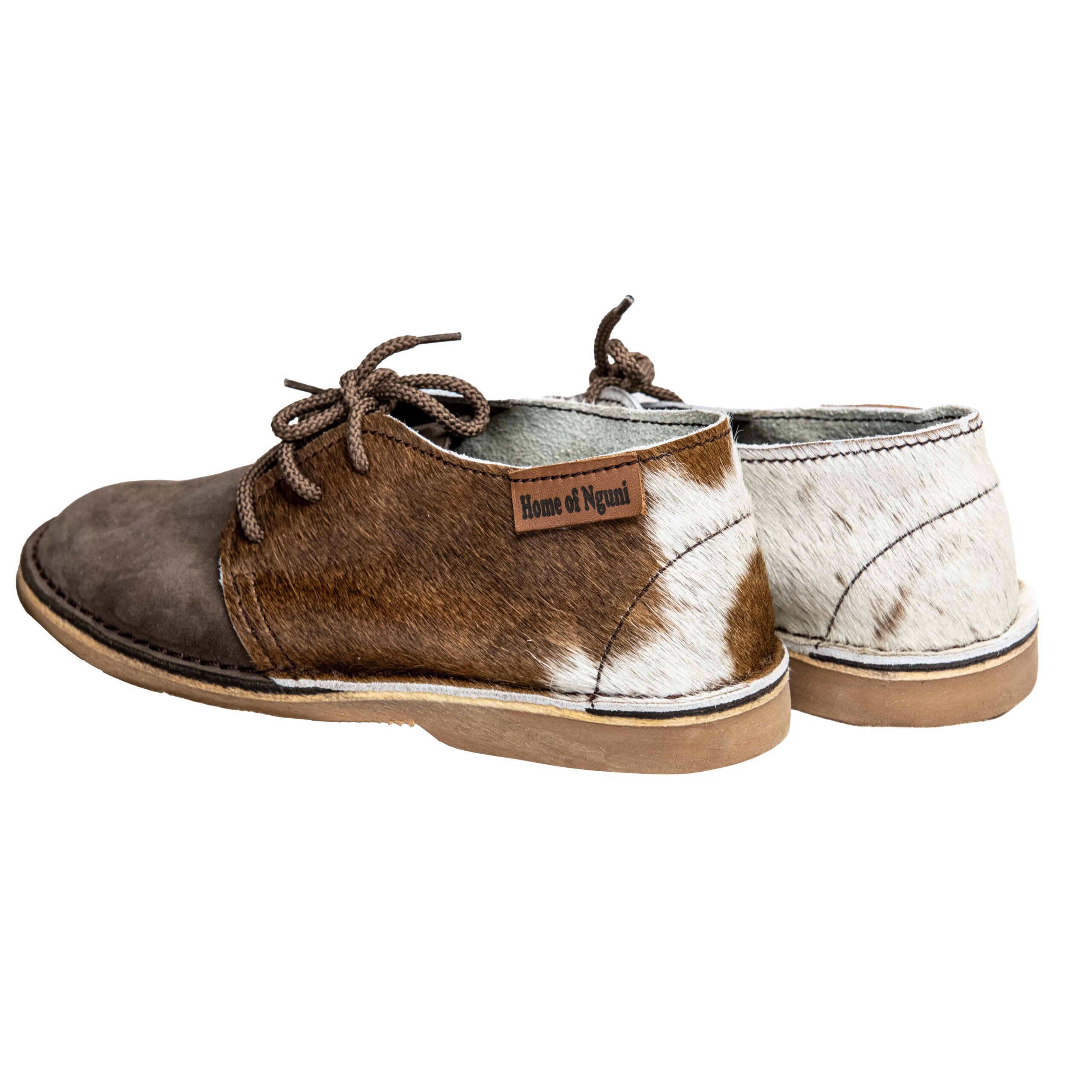
Vellies sit lower and leave more of the ankle open. That can feel less restrictive in warm conditions and makes the shoe easy to wear beneath jeans, chinos or work trousers. Neither height is universally better. Decide whether you want the footwear to feel like the main feature or a distinctive finishing detail.
2. Fit points and sizing checks
When comparing Nguni boots vs vellies, check more than the number printed on the size label. A vellie must fit the foot length and width while allowing the sock thickness you normally wear. A boot introduces additional fit points around the ankle, instep, shaft and calf. People with a high instep or wider calf should confirm measurements before ordering.
- Measure both feet near the end of the day.
- Use the larger foot when comparing measurements.
- Wear the type of socks intended for the shoes.
- Ask whether the listed size runs true, narrow or generous.
- For boots, confirm the shaft height and calf opening.
- Check exchange conditions before selecting a gift size.
Leather may soften with wear, but an uncomfortable new shoe should not be treated as a sizing plan. Toes need room, heels should not slip excessively and seams should not create sharp pressure. Ask Home of Nguni for current sizing guidance if you fall between sizes.
3. Warm weather and cool weather
Weather can help settle Nguni boots vs vellies because South African conditions change by region and season. A lower vellie can be a practical choice for mild days because there is less material around the lower leg. Boots offer more coverage for crisp mornings, winter outings and layered outfits. However, ordinary leather fashion footwear should not automatically be treated as waterproof or as specialist protection for extreme conditions.
Use a care product suitable for the specific leather if rain is expected, and test it on a discreet area first. If either style gets wet, remove loose dirt, stuff it lightly to hold its shape and let it dry naturally away from heaters and direct sun. Confirm material and sole details before planning muddy, technical or very wet use.

4. Everyday comfort and break-in
Comfort depends on the last, sole, leather, construction and individual foot, not only on whether the shoe is called a boot or a vellie. Vellies are often appreciated for a straightforward shape that can move from a day at the office to an easy weekend. Boots may feel more supportive around the ankle, although their taller structure can need more gradual wearing-in.
Start with short periods at home, then increase wear once you know where the leather flexes. Do not use a long event or full-day trip as the first test. A Kalahari Vellies care and hiking guide similarly recommends accurate fitting, suitable socks and short walks before longer outings. Its outdoor advice is useful general context, but always judge the exact Home of Nguni product and your route rather than assuming every vellie is a specialist hiking shoe.
5. Outfit versatility
For Nguni boots vs vellies, vellies have the edge when you want one pair to work across many easy outfits. The ladies Nguni vellies can add natural texture beneath jeans, a linen dress or a midi skirt, while the men’s Nguni vellies work with denim, chinos and relaxed tailoring. Keep surrounding patterns restrained so the authentic hide remains visible.
Boots create a stronger seasonal statement. Wear them with straight or slim trousers that sit cleanly over the shaft, or make the full height visible with a dress or skirt. A black-and-white pattern looks graphic beside charcoal, black and stone, while brown or brindle works naturally with denim, olive, tan and cream.
6. Natural pattern and visual impact
Every genuine Nguni hide has individual markings. A boot usually presents a larger patterned area, so it becomes a clear statement even under a simple coat or long trouser. A vellie shows a smaller area and may be easier for someone trying naturally patterned footwear for the first time.
Ask for photographs of available pairs when the exact balance of colour matters. The pattern shown in a product photograph may not be identical to the pair available in your size. The broader Nguni vellies guide and collection explains why natural variation is part of the appeal rather than a flaw.
7. Care, storage and frequency of wear
The care routine for Nguni boots vs vellies is similar: remove surface dust gently, protect the leather from soaking, dry it slowly and use only compatible conditioning products. Boots need upright storage so the shaft does not remain folded or creased. Vellies take less cupboard height and can be easier to rotate into a daily wardrobe.
- Brush dry dust in the direction of the hair.
- Use a clean, slightly damp cloth only where appropriate.
- Never place wet leather beside a heater or fire.
- Condition smooth leather sparingly with a suitable product.
- Test any treatment where a mark will not be obvious.
- Let footwear air before returning it to storage.
- Keep boots supported and vellies free from crushing weight.
Use this five-minute footwear test before ordering
If photographs have left Nguni boots vs vellies feeling evenly matched, turn the choice into a short home test using footwear you already own. Put on the socks and trousers you expect to wear most often, then compare one low-cut shoe with one taller boot. The aim is not to judge brands or materials, but to notice which profile supports your normal movement and wardrobe.
- Walk ten minutes indoors and notice heel movement, toe room and pressure around the ankle.
- Sit and stand several times to test flex across the forefoot, instep and boot shaft.
- Climb a few steps and check whether the heel lifts or the shaft restricts movement.
- Try usual trouser hems to see whether they sit neatly over, inside or above the footwear.
- Look in a full-length mirror from the front and side, then photograph both silhouettes.
When comparing Nguni boots vs vellies, repeat the test near the end of the day, when feet can be slightly fuller. If one foot is larger, judge the fit by that foot. A comfortable shape should hold the heel without sharp rubbing, leave sensible toe space and allow natural flex. Any new pair should still be confirmed against the seller’s measurements and exchange terms.
To settle Nguni boots vs vellies, next list three real occasions from the coming month: perhaps an office day, a weekend lunch and a cool outdoor event. Mark which silhouette works with the clothes already in your cupboard. This prevents a striking pair from becoming footwear you admire but rarely use. Also check whether the chosen height works when seated, driving and walking on ordinary paving, because a pair should feel practical during the quiet moments between occasions too. Note any discomfort immediately so it is not mistaken for a normal break-in issue when you compare the seller’s sizing advice.
Finally, score Nguni boots vs vellies from one to five for fit confidence, outfit frequency, climate and storage. Double the score for outfit frequency because regular wear usually matters most. If the totals are close, choose the lower-risk size first and ask Home of Nguni to show the current hide patterns available in that size.
Which style suits your routine?
For Nguni boots vs vellies, choose boots if you want more coverage, a taller statement and footwear that anchors cool-weather outfits. Choose vellies if you value a low profile, easier year-round styling and a recognisably South African shoe that works with casual and relaxed smart clothing. If both suit your wardrobe, start with the style you can wear most often and add the second when you know your preferred fit and colour family.
Frequently asked questions
What is the main difference between Nguni boots and vellies?
Boots have a taller profile that covers more of the ankle and lower leg. Vellies are lower-cut veldskoene with an easy everyday shape.
Are Nguni vellies suitable for hiking?
Some people use sturdy vellies for outdoor walking, but suitability depends on the exact sole, fit, support, weather and terrain. Confirm the product specification and use specialist hiking footwear for technical routes.
Should boots and vellies be the same size?
Do not assume so. Measure both feet, consider sock thickness and ask for current sizing guidance. For boots, also check the instep, shaft and calf opening.
Will my Nguni footwear look exactly like the product photograph?
Not necessarily. Genuine Nguni hide has naturally different colours and markings, so ask to see available pairs if a particular pattern is important.
Can Nguni boots or vellies get wet?
Avoid soaking leather footwear. If it gets wet, remove surface dirt, retain the shape with light stuffing and dry it naturally away from heat and direct sun.
Which is easier to style every day?
Vellies are often the most flexible everyday option because their low profile works with jeans, chinos, skirts and relaxed dresses. Boots make a stronger cool-weather statement.
Choose your Nguni footwear with confidence
The best answer to Nguni boots vs vellies comes from your own routine. Compare height, fit, climate, comfort, styling, pattern and care rather than choosing on appearance alone. Boots deliver confident coverage and impact; vellies offer relaxed versatility. Whichever you select, confirm measurements and the current hide pattern before ordering so your distinctly South African pair is one you will genuinely enjoy wearing.